Talking Turkey with Ryan
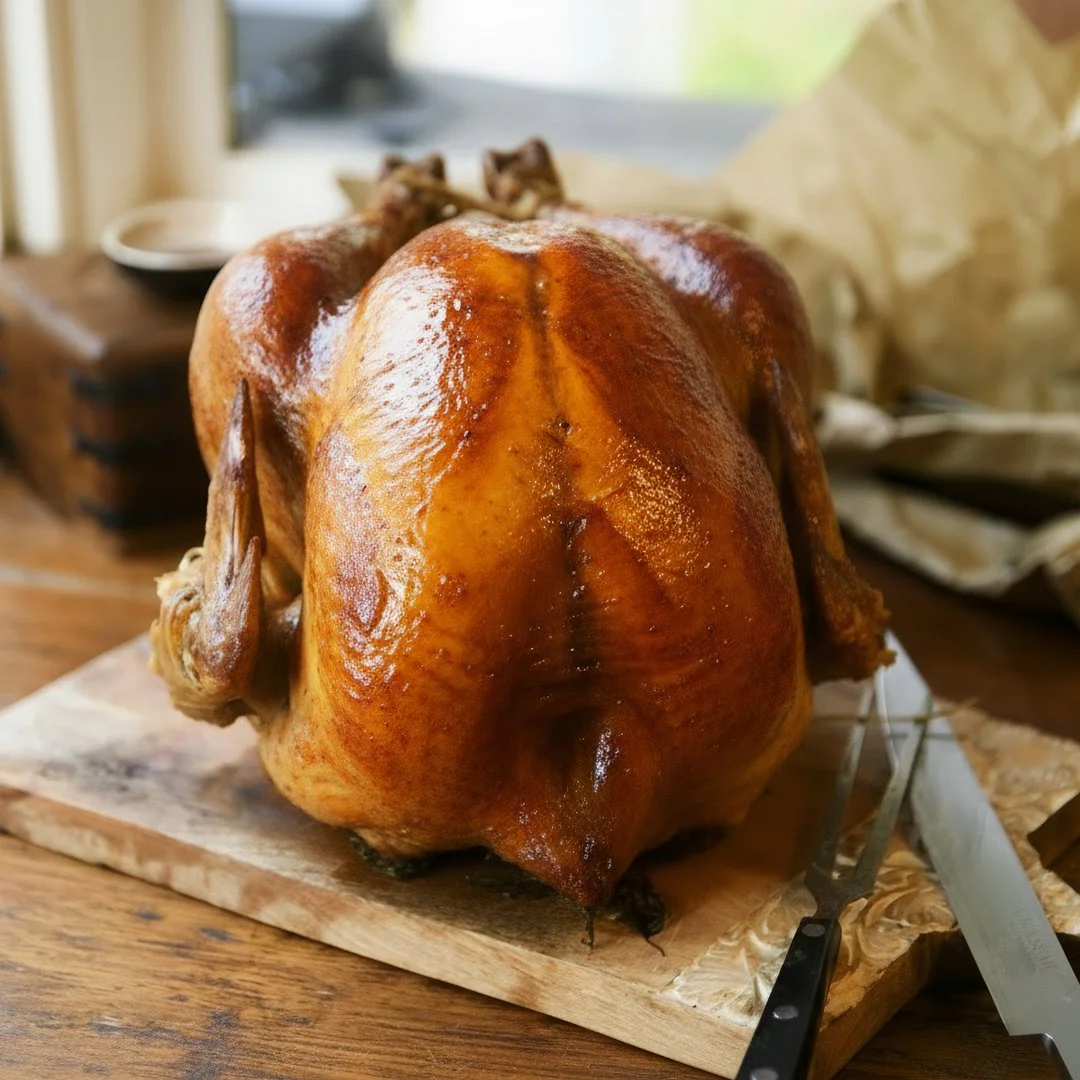
There are lots of things to consider when cooking a Turkey, so let’s break it down. Rather than attempt to provide a singular definitive recipe, I will cover the essential details for each step. This will help you understand a recipe you have used before, and why specific steps are followed.
If you are searching online, think about the sources you are using. Try to stick with cooks you trust, and remember that whilst flavours can be easily changed, basics like cooking and resting times are matters of science, so there isn’t a miracle way to halve the time it takes.
You need to defrost your Turkey in the fridge, allow around half an hour per kilogram for cooking, and finally, butter or another animal fat in generous quantities is non-negotiable.
Size
A reference point always helps. If you are going to roast a turkey, I will assume you have managed a roast chook at some point; if not, perhaps we’d best have a chat first!
Chicken sizes correspond to their weight: size 16 (medium) is 1.6kg, size 24 (large) is 2.4 kg. Consider how many you typically feed with a roast chicken, and remember that at Christmas, there are often more sides and additional meats on offer. Leftovers are great, but you probably don’t want to be still repurposing frozen turkey at Easter time.
As a guide for whole turkeys, based on weight, they will serve the following number of average adult eaters.
Approx 500g raw weight/person (remember there is bone)
3kg for 6-7
4kg for 8-10
5kg for 10-12
6kg for 12-14
7kg for 14-16
8kg for 16-18
9kg for 18-20
If you are choosing boneless or crown roasts, it’s roughly 300g per person. This may sound like a lot, but remember, around 30% of the weight is lost during cooking.
Defrosting
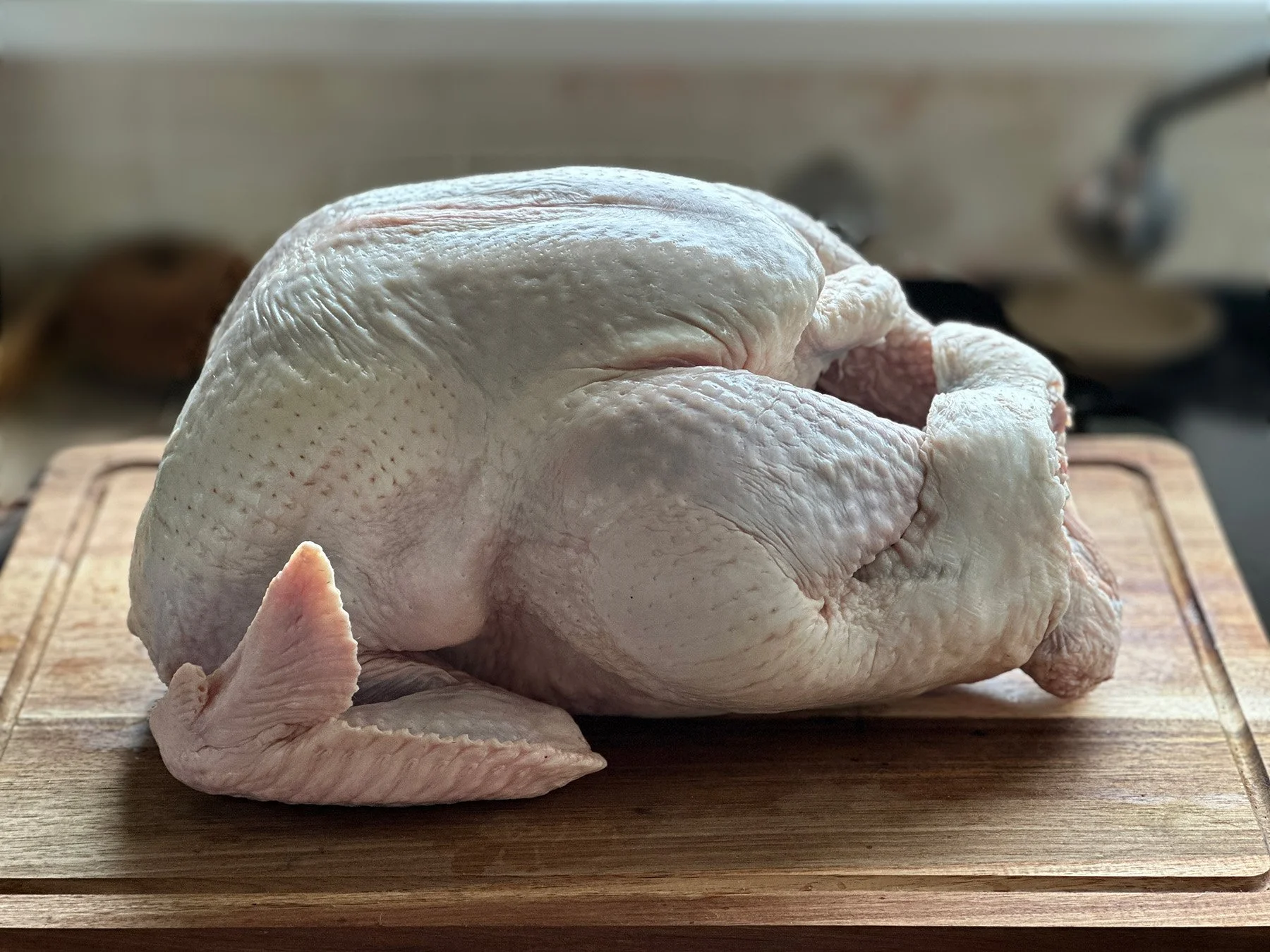
Turkeys are best processed in cold weather, as this is when they have the most fat and the best size. It is also a very seasonal meat, so even in the northern hemisphere, where the festive season aligns with the cold weather, it is typical to purchase turkeys frozen.
Big birds take a long time to defrost. 10 hours per kilogram. So a 9kg turkey will take around 4 days. Due to the prolonged defrosting time required, a little food safety lesson is definitely in order.
You MUST NOT defrost large cuts of meat, especially poultry, at room temperature. When people do this, the outside of the bird, and the cavity, exceed the cold temperatures needed to prevent bacterial growth, and it can be hazardous, resulting in food poisoning.
Defrost your turkey in the fridge. This may seem counterintuitive, but the slow defrost and refrigeration will keep it below 5°C, and still allow the meat to thaw thoroughly. Once you are ready to prepare the turkey, remove it from the packaging and use a paper towel to absorb any moisture from the cavity or the skin.
Most poultry including turkeys will have been vacuum sealed so it is quite normal for there to be a strong odour – these are just gases being emitted and nothing to worry about. Washing poultry is not recommended as it risks splashing raw poultry juice about the kitchen – definitely a no-go in Australia during Summer with blowies - the hoons of the insect world – doing chap laps of the kitchen, revving their engines just waiting to turn the most innocent-looking benchtops into a petri dish of gastro and week off your tucker.
Cooking and Resting Times
To help with your planning, I will jump ahead to the cooking times, more details will be covered in the subsequent sections.
There are many different methods for cooking a turkey, and lots of flavouring options. Whichever you choose, resting is critical. Remember, a large turkey takes around 5 hours to cook so that it won’t go cold quickly. Resting allows the juices to disperse evenly, and is essential to avoid dry meat.
At 180ºC (fan forced), your turkey will need approximately 30 min per kg.
5kg ~ 2.5 hours
7kg ~ 3.5 hours
9kg ~ 4.5 hours
For all these times, remember to add one hour out of the fridge before cooking, plus a minimum one hour of resting, up to 50% of the cooking time. Resting is done in a warm, but not heated, place (away from the aircon or draft) and your turkey should be covered loosely in foil and towels.
Flavouring and stuffing a whole turkey
If you plan to stuff a whole turkey, it is best tucked into the neck cavity rather than the tail. This avoids making the centre of the bird really dense, which will prolong cooking times. I recommend making a delicious tray of stuffing as a side dish, and then placing herbs and citrus into the cavity to add flavour.
Moisture in meat mainly comes from from fat, which is why dry-aged steaks that will look lest moist when raw, are juicy and delicious, while lean, lower grade steaks can quickly become dry or tough when cooked, despite looking much juicier when raw. The intramuscular fat or fat you add is the hero.
With turkey, we need to help maintain the fat by adding more than is naturally present. An abundance of butter or lard, mixed with herbs like sage, rosemary, and citrus, should be applied under and on the skin, as well as in the cavity. As it melts and gathers in the tray, you can baste the bird to finish browning it, and this is an excellent base for a pan gravy. If in doubt at any point, add more butter!
Cooking a whole turkey
Covering the turkey with foil for the majority of the roasting time is recommended almost universally. This protects the breast and prevents overcooking or premature browning. The skin will take about an hour to brown, so when you have determined your cooking time; make a note to remove the foil one hour before the turkey will be cooked.
A roasting trivet will help keep the underside from being pale. You can also add vegetables to the bottom of the roasting dish, which will help add extra flavour to your gravy.
Cook your potatoes and any other vegetables that you plan to serve separately. This prevents overcrowding and improves the presentation. Under your turkey or other roast, onions, leeks, celery and carrots are all excellent, they develop a great a flavour during a long cook and supercharge a pan gravy. If some of these look good enough for the Christmas table, you can serve them alongside the sliced turkey, or reserve them for reinvention as leftovers.
Is it cooked yet?
Nobody wants dry or undercooked turkey, and the best way to ensure it is cooked correctly is to use a good-quality digital thermometer. If you have a new device, calibrate it with boiling water to ensure it is accurate. Professional cooks spend up to several hundred dollars for accurate instant-read thermometers. If you are erring on attaining minimum doneness for maximum moisture, you must be certain about the accuracy of your thermometer.
When cooking any meat, taking the internal temperature with a probe thermometer is the most accurate way to determine doneness. With turkey or any poultry, 65ºC is the absolute minimum for every part. This includes the thighs and breasts near the bone, so you will need to check the temperature at multiple points. 65ºC will maintain some blush in the juice and near the bone, it isn’t raw, but may not be to everyone’s taste, so an internal temperature of 68º-70ºC near the bone is a wise balance.
Do the maths
Cooking time depends on the weight; it may also vary depending on your oven. Work out your process well before Christmas Day and write it down – not just the cook time but work backwards from when you want to serve. Nobody wants to be googling their cooking time on Christmas morning, only to realise lunch is going to be very late.
Decide when you wish to be serving lunch. (eg 1.00pm)
Calculate the cooking time (eg 7kg = 3.5 hours) then add one hour to account for removing the turkey from the fridge one hour before your cooking start time, and also your resting time. You need to allow a minimum of one hour resting. If you need your oven for other cooking or reheating, you will have 1-2 hours while your turkey rests, longer for a larger bird, so factor the time you need for other dishes.
A 3.5 hour cook time, means starting the process no less than 5.5 hours before you plan to serve.
You also need to ensure that your oven is pre-heated for at least one hour. So, turn it on as soon as you take the turkey out of the fridge. Yes, really! You are about to roast something big, so make sure the oven is thoroughly heated or you will need even more time to cook it.
Your running sheet with times for a 7kg turkey will look something like this:
6:30am - Remove turkey from fridge and turn on the oven.
7:30am - Place turkey in oven for a total cook time of 3.5 hours
10:00am - Uncover, remove foil and roast until golden and cooked through
11:00am - Remove turkey from oven, wrap and rest
1:00pm - Serve lunch
If you are pushing the maximum capacity of your oven, or if you are new to cooking, allow extra time and a longer rest. The turkey does not have to be piping hot; a heated serving platter and hot gravy will keep it at a great eating temperature.
Good luck, and remember to enjoy! If anything takes longer than you expect, or you find your oven is struggling, relax, and let everyone enjoy a drink and some nibbles. A few extra drinks before lunch is much more conducive to enjoying the meal than miliary precision timing.